YOU AND THE UNIVERSE
Everything that exists, exists in the universe. Compare yourself to a whale, or a dinosaur. They are enormous. Then think about how big your city is and how much space you take up in your state, your country, or your continent. Then imagine the Earth. You’re not very big now. Hold on it gets worse.
The Earth is pretty small when you compare it to Jupiter. Jupiter is pretty small compared to the Sun. As you go on, there are millions of suns in our galaxy and thousands of galaxies in the universe. No one really knows how many. There are some scientists and mathematicians with theories, but nobody really knows. We have discovered a few things and you can check them out in the related links.
WHAT MAKES A STAR?
You're here to learn about what a star is and a little bit about them. Once again, a star is basically a ball of gas that has nuclear reactions occurring in its atmosphere. As those reactions occur, huge amounts of energy are released into space. The energy is released as electromagnetic radiation (EM). That EM radiation includes visible light, UV (ultraviolet) light, IR radiation (infrared), x-rays and gamma rays. There are also very small particles leaving the star. Those particles are byproducts of the nuclear reactions.
COLORS
We have a yellow star. That’s the Sun. Some systems have red stars. Others have a blue tint. The color of a star depends on its surface temperature. Bluer stars have a higher surface temperature. Lower temperature stars give off a lot of red light.
BLACK HOLE BASICS
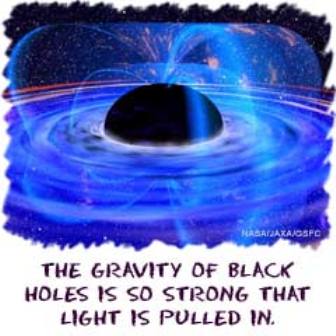
Black holes are areas in space where there is a huge amount of mass in a very small space. The gravity of this mass is so great that everything in the area is pulled toward the mass. Even light, with its tiny mass, is pulled into the center of the hole. No object can escape the gravitational pull of a black hole.
Have we ever seen a black hole? No. Actually you can’t see a black hole because no light escapes the event. Astronomers use other ways to look for black holes. Since they have large masses and gravities, they affect the surrounding stars and systems. They have found evidence of black holes in the dark centers of galaxies and systems that emit large amounts of x-rays.
STAR LIFE AND DEATH
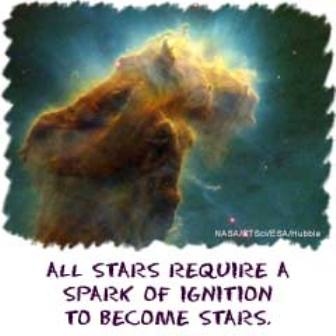
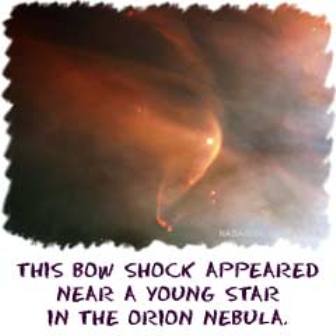
Just like living organisms, stars have a life cycle. In the same way that you are born, develop, age and die, stars do the same things. One big difference is that stars don’t need parents. Stars are born from huge clouds of gas and dust. It’s amazing how that gas and dust are probably the most boring things in the universe and they can become everything, asteroids, planets and even stars. So you’ve got that huge cloud of dust and gas. Astronomers call that cloud a nebula. That’s when it all starts to happen.
WHAT IS A SYSTEM?
A system is a star (or two) and a series of objects that revolve around that star. The objects could be gas giants like our Jupiter or small rocky planets like our Mercury. There may also be other non-planetary objects. You will probably find moons around the planets and asteroids/comets zipping around the star in highly elliptical orbits. Just as in biology, a system is made of many parts that all interact with each other.
WHAT MAKES A PLANET?
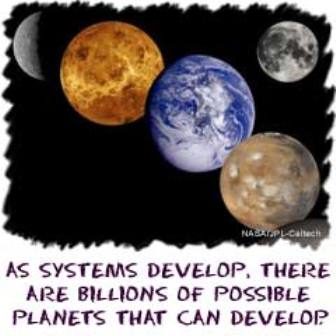
You can learn more about planets in the Solar System section but let’s give a quick overview that a planet is made up of heavy elements. Stars are mainly made of hydrogen (H) and helium (He). Planets generally have all of the other elements in their crust and core. You will find large amounts of iron (Fe) and minerals. Also, planets do not have the nuclear reactions igniting their atmosphere.
THE SUN IN THE MIDDLE
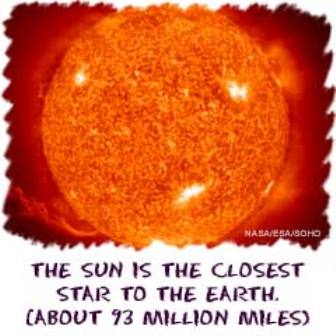
Everything in the Solar System orbits around the Sun. It’s mass is greater than all of the other planets combined. Even though the Sun is huge, it is small when compared to other stars in the galaxy. Even though it is smaller, the Sun provides all of the light for the Solar System. As far as astronomers are concerned, our Sun is named Sol. The entire group of Sun and planets is called the Solar System. If another star were named Andros, that system would be named the Androsian System.
YOUR BLUE HOME
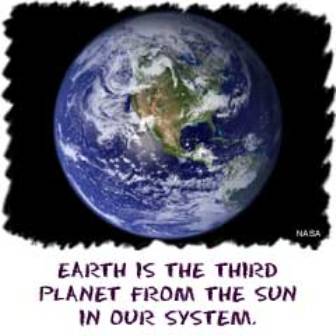
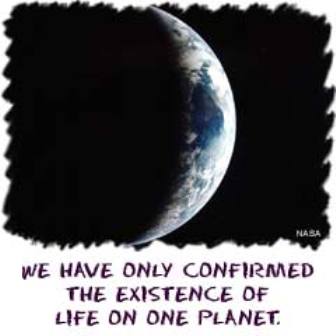
The third planet from the Sun is your home. The Earth is the only known planet where life can survive. As far as we know, there is no other planet in the universe like Earth. We have a very narrow temperature range that allows water to remain a liquid. Life
has developed over millions of years because of that liquid. What else makes us special? Most of our atmosphere is made of nitrogen (N), a relatively inert gas. If we had clouds of sulfuric acid or methane (like other planets), life may have never developed.